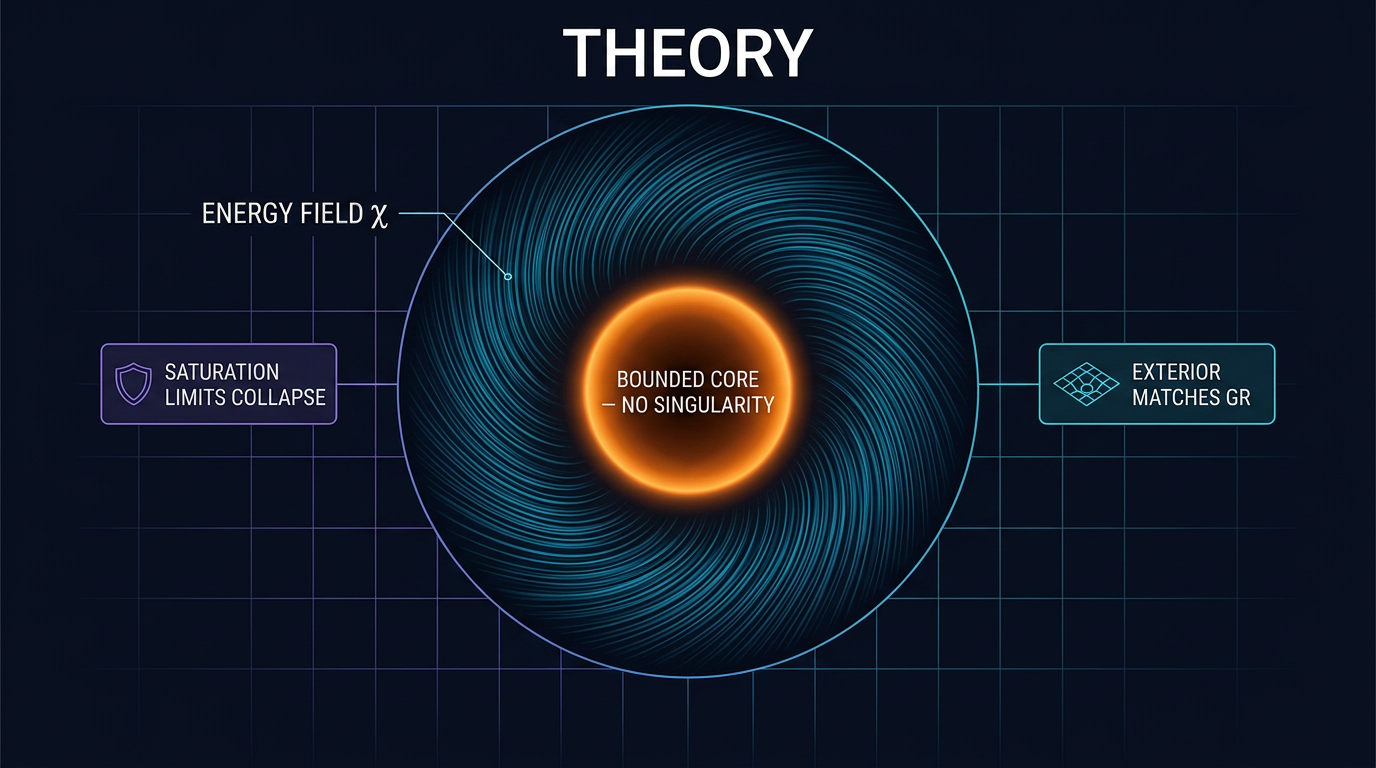
A bounded-response theory of gravity with a covariant field structure
The Energy Equilibrium Theory treats strong gravity as a regulated response problem: when compression grows extreme, the effective source saturates and a displacement field carries the nonlinear correction.
- Core mechanism
- Saturating response plus field-driven anisotropic stress
- Observable angle
- Mass-independent core ringing scale
- Open question
- Whether full dynamical collapse settles into the regulated state
The theory is designed to stay readable without hiding the hard parts
Rather than replacing gravity everywhere, the model concentrates new physics in the regime where ordinary collapse points toward singular behavior.
Theory pillars
Gravity is treated as a macroscopic response to energy imbalance, with nonlinear feedback preventing unbounded collapse.
The χ sector generates radial and tangential pressures that need not match, creating a concrete mechanism that can resist collapse.
Far from saturation the model tracks GR, so the new physics is concentrated where ordinary collapse theory struggles most.
Key equations
These expressions define the framework compactly, while the notes underneath translate each one back into physical language.
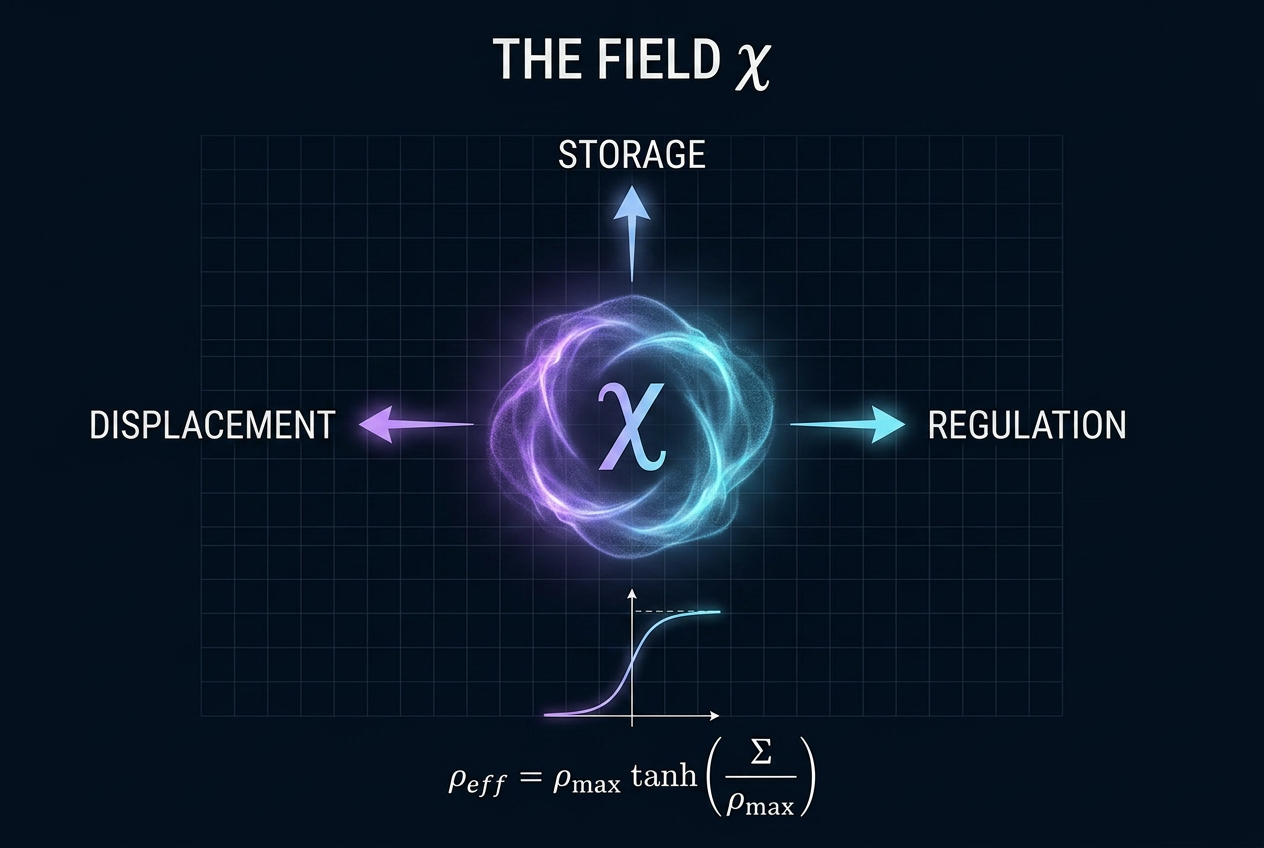
At low Σ this reduces to the ordinary response, while at high Σ it caps the effective density seen by curvature.
The excess is not destroyed; it is redirected into a regulated stored component that changes the collapse interior.
The action embeds the saturation idea into a covariant field theory rather than treating it as an ad hoc cutoff.
The displacement field reacts nonlinearly to compression and naturally softens extreme regimes.
Ordinary matter and the new field both source geometry, letting the theory recover familiar behavior outside the regulated core.
Why anisotropic stress matters
The χ field does more than soften density growth. It introduces directional pressure differences that can actively oppose runaway collapse.
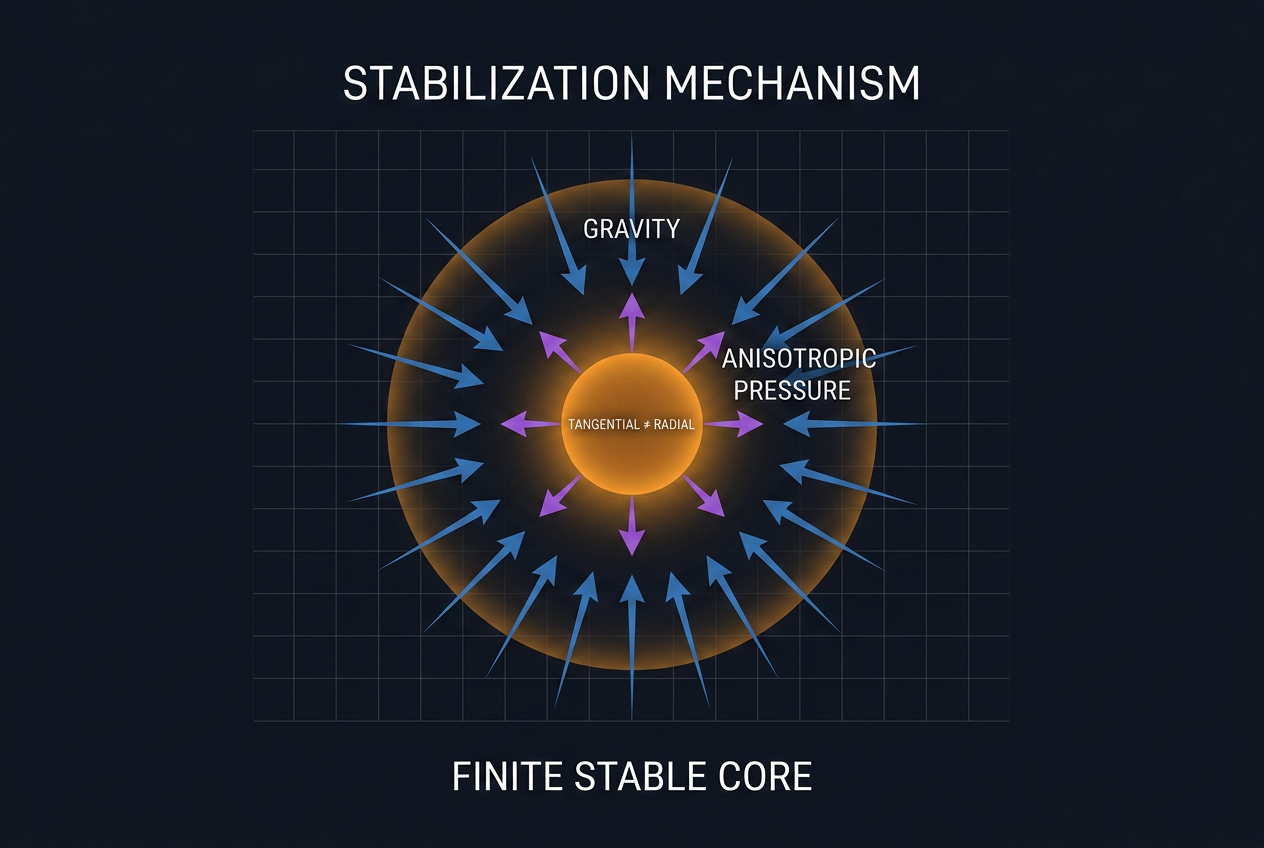
In this picture, radial pressure and tangential pressure need not remain equal. That asymmetry is not a flaw to be removed; it is the working mechanism that can stabilize the interior while keeping the outside close to ordinary black-hole expectations.
Stabilization mechanism
It supplies an explicit stress channel that can resist further compression.
It helps explain how saturation can lead to a finite core rather than a simple numerical cap.
It preserves the possibility of horizons outside a regulated interior instead of forcing a fully horizonless object.
Solid structure versus speculative interpretation
The equations and stabilization mechanism form the strongest part of the theory. The entanglement interpretation remains a promising deeper layer, not yet the finished foundation.
More established
- The saturating effective density law.
- The covariant χ-field action and its equation of motion.
- The role of anisotropic stress in regulating collapse.
- Recovery of GR-like behavior away from the saturated core.
More exploratory
- Interpreting χ as a direct measure of entanglement displacement.
- Treating distortion as a catalytic feedback loop in full dynamics.
- Linking the stored-energy sector to quantum information structure in a rigorous derivation.
A concise framing of the work as it stands today.
This site presents the current structure of the theory as a research program: a bounded-response modification of gravity with clear open questions and concrete targets for falsification.