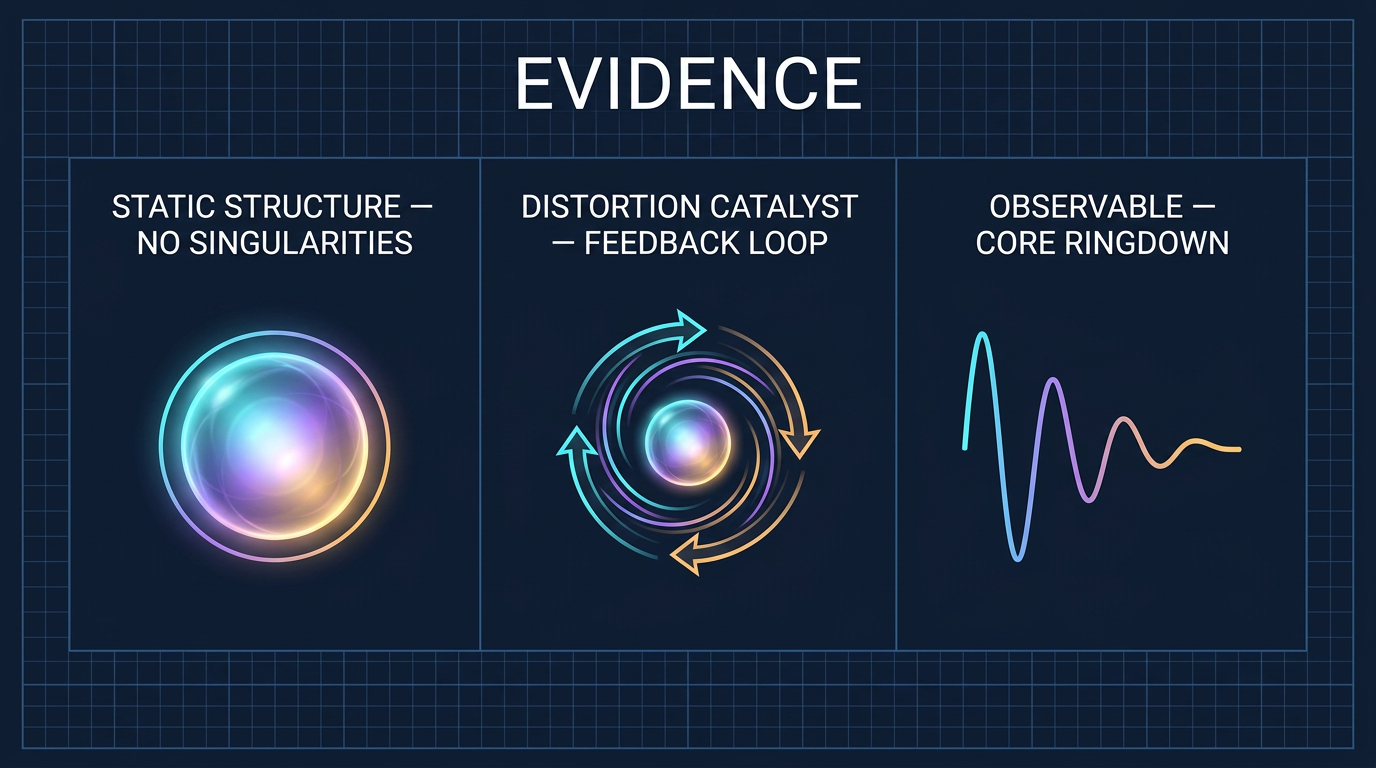
What the tests suggest so far
The current evidence is strongest in structural regularization: finite cores, recovered exterior behavior, and a plausible feedback mechanism that may halt singular collapse without erasing horizon physics.
- Core mechanism
- Saturating response plus field-driven anisotropic stress
- Observable angle
- Mass-independent core ringing scale
- Open question
- Whether full dynamical collapse settles into the regulated state
Three layers of evidence
The project currently combines analytic structure, simulation-style reasoning, and a concrete observational angle instead of relying on philosophical claims alone.
Consequences & predictions
No singularities appeared in the static models explored so far. Finite-density cores emerged while exterior behavior stayed GR-like. The framework showed regularization without immediately destroying ordinary large-scale gravity.
Saturation seems to seed distortion rather than simply stopping growth. That distortion can amplify regulation, producing a feedback loop between Σ, χ, and structural response. This turns the theory from a passive cap into an active stabilizing mechanism.
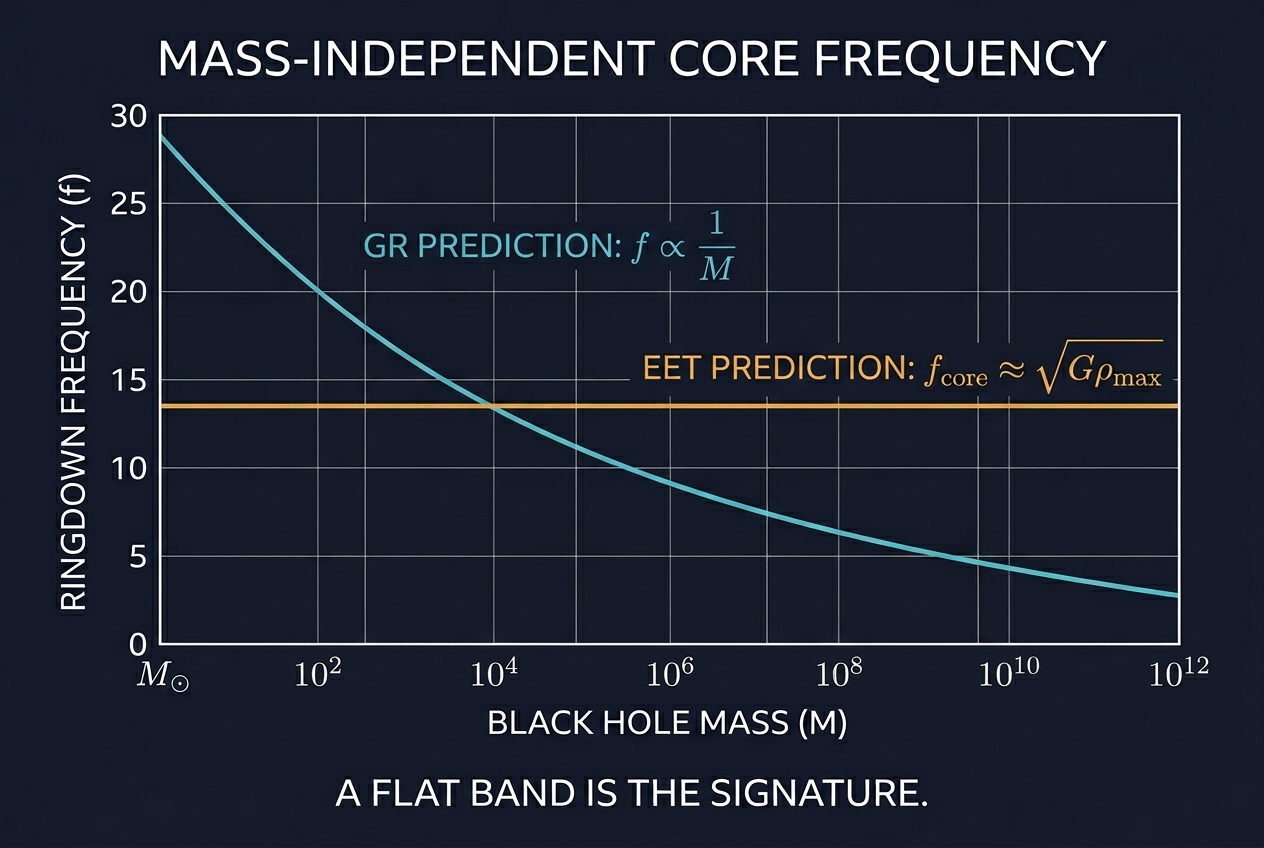
A core frequency f_core ~ (1 / 2π) √(Gρ_max) is predicted from the stabilized interior scale. Unlike GR ringdown scaling, this signature is tied to the theory's saturation density rather than only the total mass. Current detector sensitivity makes the signal difficult, but existing data does not exclude it.
Finite core, horizon outside
The theory's updated picture of black holes: externally familiar, internally regulated.
Why the frequency prediction matters
The standout observable is a core scale that depends on the saturation density ρ_max, producing a ringing frequency that does not simply follow the familiar 1/M scaling of GR modes.
If this feature exists, its weak amplitude may hide inside residual structure rather than appearing as an obvious standalone line in current catalogs.
Frequency readout
Scaling tests were consistent with the idea that the signal is not purely mass-set.
Detectability studies suggest the effect could be faint enough to evade current searches.
That makes the theory testable without being already falsified by present observations.
What is supported, plausible, and unresolved
Separating these categories keeps the project credible: the strongest case is in its regulated-collapse structure, not in every downstream interpretation.
Supported now
- Bounded effective density response
- Covariant field-theory formulation
- Anisotropic-stress stabilization mechanism
- GR-like exterior behavior in explored regimes
Plausible, still developing
- Distortion-as-catalyst feedback
- Entanglement-displacement interpretation
- Secondary gravitational-wave structure
Not yet demonstrated
- Full dynamical collapse proof
- Direct detection in gravitational-wave catalogs
- Complete Hawking-sector implications
A concise framing of the work as it stands today.
This site presents the current structure of the theory as a research program: a bounded-response modification of gravity with clear open questions and concrete targets for falsification.